
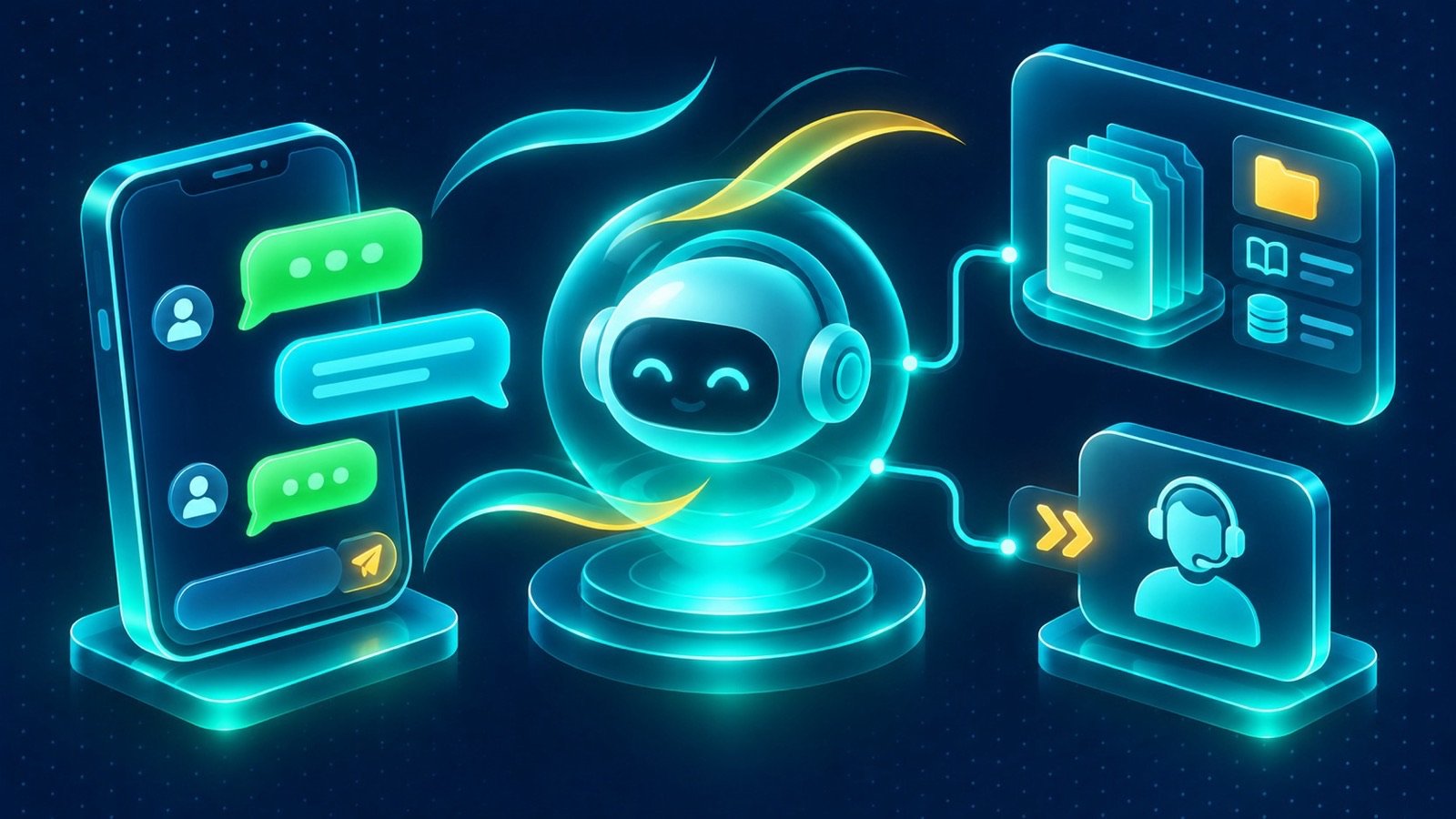
In brief: Discover how an Arabic AI agent for WhatsApp in Saudi Arabia can answer enquiries, qualify leads and support customers with human oversight.
A customer sends a WhatsApp message in Arabic asking about a service, switches to English to clarify a requirement, and then asks whether an appointment is available. The business needs to understand the request, provide accurate information and decide what should happen next. An Arabic AI agent for WhatsApp in Saudi Arabia can support this interaction by answering from approved company information, collecting details and connecting the conversation to a business workflow. It should also recognise when a question is unclear or a decision belongs to an employee.
For Saudi businesses, the value of an AI agent is not simply that it can generate a conversational reply. It is the ability to make customer communication useful to the organisation: qualifying enquiries, supporting bookings, routing service requests and updating connected systems. FlowAI provides Arabic and English customer agents on WhatsApp and web, with AI workflows inside the ERP and CRM. The agent can be trained on business data, while important actions remain subject to human approval.
Start with the customer task, not the chatbot personality
Before selecting a model or writing conversation prompts, identify what customers are trying to accomplish. A restaurant may need to answer questions about its services and handle booking requests. A professional services firm may need to collect project requirements before a consultant follows up. An online store may need to answer questions about orders and direct customers to support.
These are different workflows. Each needs its own approved information, questions, system access and escalation conditions. A general-purpose chatbot that tries to answer everything may produce responses that sound convincing but are not grounded in the business’s actual policies or records.
Begin by choosing a small set of tasks with clear outcomes:
- Answer common questions about services, products and business procedures.
- Collect information needed to understand a new enquiry.
- Qualify leads and prepare a structured CRM record.
- Support appointment requests and booking workflows.
- Provide approved information about an order or service request.
- Route complaints, exceptions and sensitive questions to an employee.
For each task, define what the agent may answer, what information it needs and what it must never decide independently.
How an Arabic AI agent for WhatsApp in Saudi Arabia should be designed
Language is only one part of the design. The agent needs a controlled source of business knowledge, a way to identify the customer’s intent, access to the right workflow and a safe method for transferring the conversation to a person.
Arabic AI agent for WhatsApp in Saudi Arabia: connect language to approved business knowledge
A practical design starts with approved information such as service descriptions, product details, policies, frequently asked questions, booking rules and internal procedures. These sources are reviewed and prepared so the agent can retrieve relevant information when responding.
When a customer asks a question, the agent interprets the message and searches the approved knowledge available to it. It then prepares a response based on the information it can access. If the answer is missing, outdated or ambiguous, the agent should say that it needs assistance or ask a clarifying question instead of inventing an answer.
This approach is often described as grounding an AI response in business knowledge. It does not eliminate mistakes, so the source documents must be maintained and the agent’s answers tested. Product availability, current prices, appointment slots and account-specific information should come from authorised live systems when the workflow requires them, not from a static document or a language model’s assumptions.
Design for Saudi Arabic without promising perfect dialect understanding
Customers may write in Modern Standard Arabic, a regional dialect, English or a mixture of languages. They may use informal spelling, abbreviations, voice notes and expressions that depend on context. The same customer may also change language during a conversation.
An agent can be configured for Arabic and English conversations, but no system should be assumed to understand every Saudi dialect perfectly. Language quality depends on the model, the wording of the message, the available context, the quality of the knowledge sources and the testing performed for the intended audience.
Practical language design should include:
- Approved Arabic and English answers for common questions.
- Consistent terminology for products, services and internal processes.
- Examples of typical customer wording and spelling variations.
- Clarifying questions when a message has more than one possible meaning.
- Human handover when the agent is uncertain or the request is sensitive.
- Testing with real-world conversation patterns before wider deployment.
Voice-note transcription, if included, requires an appropriate speech-to-text integration and its own testing. Transcription errors should not be treated as confirmed customer instructions. The workflow should allow the agent to ask the customer to clarify important details.
Give the agent a defined role and permission boundary
An AI agent should have a specific job description. For example, a customer enquiry agent may answer approved questions and collect information, but it may not approve a discount, change a contract or promise a delivery date. A booking assistant may collect a preferred time and check an authorised availability source, but it should not confirm a booking until the configured booking process allows it.
Separate the agent’s capabilities into three categories:
- Answer: Provide information from approved documents and authorised records.
- Prepare: Collect details, draft a response, summarise a conversation or prepare a proposal for review.
- Act: Trigger a permitted system action only when the workflow and permissions allow it.
FlowAI agents can read documents, draft proposals and chase follow-ups, with a human approving every step that matters. Approval points should be explicit. For example, an agent may prepare a quotation using authorised ERP information, but an employee reviews and approves the commercial terms before the quotation is sent.
Connect WhatsApp to CRM, ERP and booking workflows
A customer conversation becomes more useful when it can update the system responsible for the next step. A lead qualification interaction, for example, should not finish as an unstructured chat. The relevant details should be available to the sales team in the CRM.
With an appropriate integration, the workflow can identify the customer, check for an existing record, create or update a lead and assign it to a team member. A booking workflow may need to check availability through a scheduling system, while an order enquiry may need authorised access to ERP or e-commerce information.
FlowAI sits inside the ERP and CRM, allowing agents to work with business context rather than operating as disconnected chat interfaces. IntellaQ Flow’s custom CRM can bring WhatsApp, email, calls and web forms into one shared inbox attached to the right customer. It also supports a sales pipeline and forecasting, quotations priced from live ERP data with e-signature, and a service desk with SLAs.
These connections require configuration and, depending on the systems involved, custom API integration. Define which system owns each record, which fields the agent can read or update and what happens when a connection fails. Do not allow an AI response to substitute for a live stock, price, account or booking check.
Practical use cases for Saudi businesses
Lead qualification and sales enquiries
A prospect asks about a service. The agent can respond using approved service information, ask about the customer’s requirements and location, and collect the details needed for a sales conversation. The CRM can then receive a structured lead and route it to the appropriate team. If the prospect asks for a special price or contractual commitment, the agent should prepare the context for an employee rather than making the decision.
Appointment requests and booking support
A customer asks for an appointment. The agent can collect the preferred service, location and time, then use a configured scheduling integration to check availability. If the system confirms that the requested slot can be booked, the workflow can proceed according to its rules. If availability is unclear or approval is required, the conversation should be handed to the relevant employee.
Customer service and order questions
A customer asks about an order or an existing service request. The agent can identify the relevant record through an authorised integration and provide an approved status update. If the order cannot be matched, the status is inconsistent or the customer raises a complaint, the agent can create or route a support request for human handling.
Document-based answers and proposal preparation
A business may have service catalogues, proposal templates, policies and technical documents that employees regularly search. An agent can retrieve relevant material and prepare a draft response or proposal. The employee reviews the content, confirms scope and pricing, and approves the final version before it is sent.
WhatsApp Business Platform requirements
For scalable API-based automation, businesses generally need the WhatsApp Business Platform, including the Cloud API. The standard WhatsApp Business app offers basic greetings and quick replies, but it does not replace the platform capabilities required for integrated AI workflows.
The implementation must account for the messaging rules. Businesses need an appropriately verified business presence and customer opt-in. Business-initiated messages require approved message templates, and the 24-hour customer service window affects which message types can be sent after a customer has contacted the business.
These rules should shape the design of reminders and follow-ups. The system needs to know whether a message is a response within the customer service window or a business-initiated message that requires an approved template. Template use, opt-in records and message delivery events should be part of the integration plan.
Privacy and data handling for an Arabic AI agent for WhatsApp in Saudi Arabia
An AI agent may process customer names, phone numbers, messages, booking details, purchase information and other personal data. Connecting these records to CRM, ERP and AI services means the business must understand how information moves between systems and who can access it.
Saudi organisations should assess the workflow in light of the Personal Data Protection Law (PDPL) and applicable requirements. Using an AI agent does not automatically make a business compliant. The organisation should review its own processing purposes, responsibilities, contracts and data practices with appropriate specialists.
Include the following in the design:
- Approved knowledge: Use current business documents and remove outdated or unauthorised material.
- Minimum access: Give the agent access only to the records and fields required for its task.
- Customer transparency: Make the automated nature of the interaction clear where appropriate.
- Consent and preferences: Maintain customer opt-in and communication preferences for messaging.
- Retention: Define how conversation logs, summaries and related customer records are retained.
- Human review: Require approval for sensitive, financial, contractual or otherwise consequential actions.
- Third-party review: Understand the roles of messaging, hosting, AI and integration providers.
Also define what happens when a customer asks to correct or remove information, or when a conversation contains sensitive details that should not be used as general AI knowledge.
Testing, monitoring and improving the agent
An AI agent should be tested as a business workflow, not just as a collection of sample questions. A response may sound natural but still be incorrect, out of date or inappropriate for the customer’s situation. Testing should include straightforward requests as well as unclear, unusual and conflicting messages.
Build a test set covering Arabic and English, mixed-language messages, common spelling variations, missing details, out-of-scope questions and requests that require a human. Check whether the agent retrieves the correct source, asks a useful clarification question, updates the right record and hands over at the correct point.
After launch, review unanswered questions, employee corrections, handover reasons and recurring knowledge gaps. Update approved documents and workflow rules through a controlled process. Changes to an agent’s permissions or knowledge sources should be reviewed before they affect live customer conversations.
Prepare your business before implementation
Before development begins, collect the information that defines how the agent should operate:
- Priority customer journeys and the tasks the agent should handle.
- Approved FAQs, service documents, product information and policies.
- Arabic and English terminology used by the business.
- CRM and ERP fields the agent needs to access.
- Booking, sales and service workflows that require integration.
- Employee teams responsible for escalation and approval.
- WhatsApp Business Platform setup, opt-in process and message templates.
- Privacy, retention, access and third-party processing requirements.
- Test conversations and acceptance criteria for each workflow.
Start with one well-defined use case, such as answering approved service questions and qualifying enquiries. Expand to bookings, order information or proposal preparation after the first workflow has been tested and reviewed by the team.
Build an Arabic AI agent for WhatsApp in Saudi Arabia around your processes
An effective AI agent is not defined by how human its replies sound. It is defined by whether it provides grounded information, understands its limits, updates the right systems and transfers responsibility when a person needs to make a decision. Arabic and English support can make customer communication more accessible, but language performance must be tested against the conversations your customers actually use.
IntellaQ Flow combines FlowAI, custom CRM and business-system integration to help Saudi businesses build these workflows with clear knowledge sources and human approval points. The right design depends on your customer journeys, existing systems, data permissions and the actions you want to automate.
Explore FlowAI and AI automation, learn about custom CRM development, or review website design and mobile app development for connected customer experiences. For an implementation discussion, contact IntellaQ Flow.
For the wider strategy and platform considerations, read our guide to WhatsApp Business automation in Saudi Arabia.
Common questions
What can an Arabic AI agent do on WhatsApp?
A configured AI agent can answer questions using approved business knowledge, collect customer details, qualify enquiries, support booking workflows and route requests to employees. Its permitted actions and escalation rules should be defined before launch.
Can a WhatsApp AI agent understand every Saudi dialect perfectly?
No AI system should be assumed to understand every dialect, expression, spelling variation or voice note perfectly. The agent should be tested with the language patterns of the intended audience, given approved knowledge sources and configured to ask clarifying questions or hand over uncertain conversations to a person.
Does an AI agent need access to company documents and systems?
It needs access to the approved information required for its tasks. This may include selected service documents, FAQs, policies or authorised CRM and ERP records. Access should be limited by role and workflow, and sensitive actions should require human approval.
Can an AI agent book appointments and qualify leads?
Yes, when connected to the relevant booking or CRM workflow. The integration must define required customer details, availability checks, booking rules, lead fields and confirmation steps. If a booking requires employee approval, the agent should hand it over rather than confirming independently.
What is required to deploy an AI agent on WhatsApp?
Businesses generally need the WhatsApp Business Platform and a suitable integration, together with a verified business setup, customer opt-in and approved templates for business-initiated messages. They should also prepare approved knowledge sources, escalation rules, privacy controls and test scenarios.