
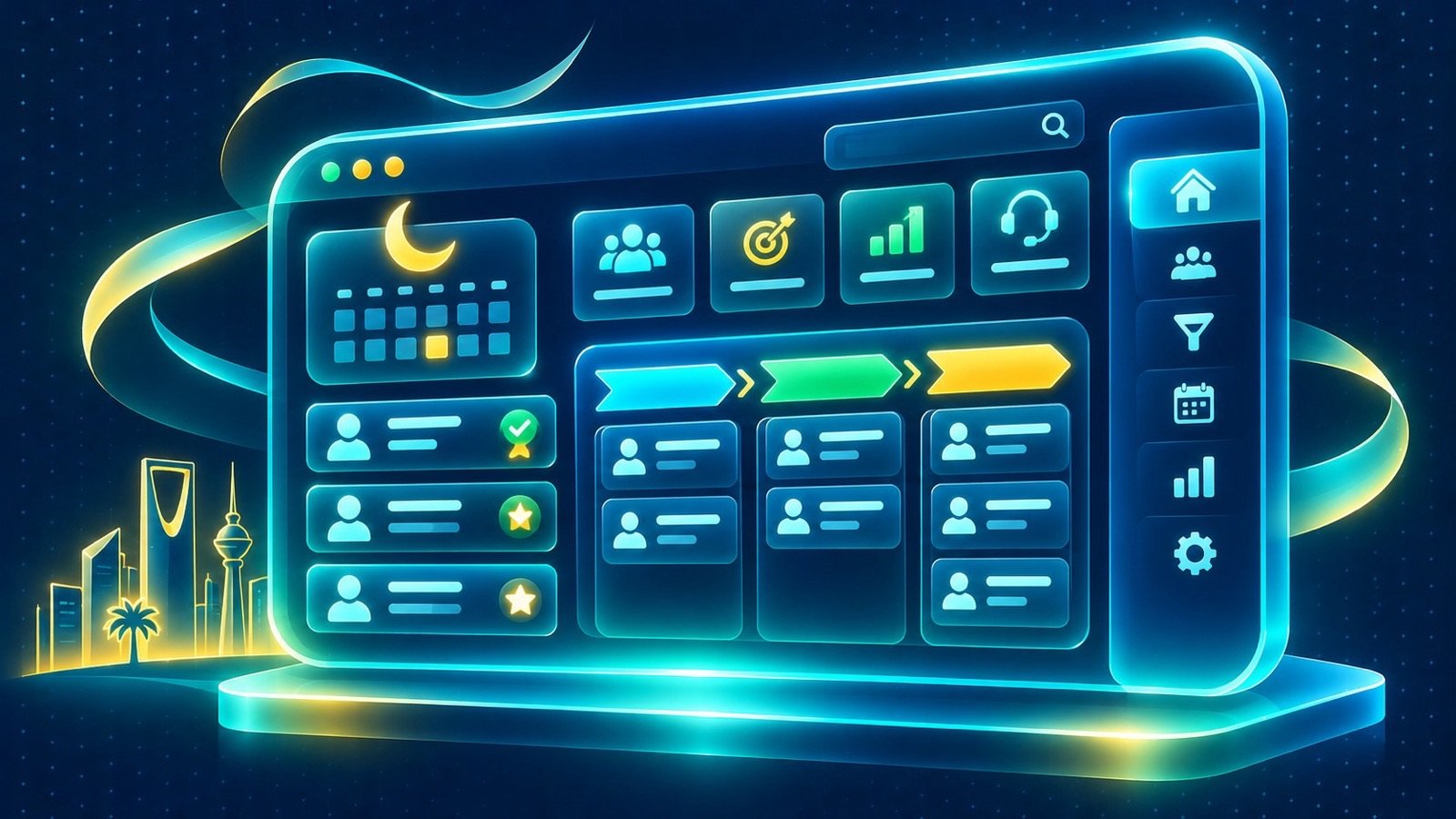
In brief: Explore Arabic CRM software for Saudi businesses, including RTL interfaces, Hijri dates, customer communication, sales workflows, and local requirements.
For teams that work primarily in Arabic, the language of a business system affects how easily employees can manage customer relationships every day. A translated menu is not enough if forms, tables, search results, reports, and customer documents remain difficult to use. Choosing Arabic CRM software for Saudi businesses means evaluating how well the system handles Arabic communication, local business workflows, and the practical needs of teams that may also work in English.
Saudi organisations often manage customer relationships across several departments and channels. Sales employees follow opportunities, service teams handle requests, and managers need visibility into customer activity and business performance. A suitable CRM should connect these activities while presenting information in a format employees can understand and use consistently.
What makes a CRM genuinely suitable for Arabic-speaking teams?
A CRM is more than a database with translated labels. Its language support affects the entire user experience, from navigation and data entry to search, reporting, notifications, and documents. If the interface is only partially localised, employees may switch between languages or rely on informal workarounds to complete routine tasks.
Evaluate the system using realistic examples from your business. Create test customer records containing Arabic names, English company names, mixed-language contact details, and notes written in both languages. Check how those records appear in lists, forms, search results, and reports.
Pay attention to the following areas:
- Arabic interface: Navigation, buttons, labels, validation messages, and help text should be understandable and consistent.
- Right-to-left layout: Forms, menus, tables, and page structures should follow the correct reading direction.
- Mixed-language records: Arabic and English information should remain readable within the same customer profile.
- Search and filtering: Employees should be able to find records using the names and details they actually enter.
- Documents and notifications: Quotations, messages, and generated documents should preserve the intended language and layout.
- Reporting: Dates, currency values, labels, and customer names should remain clear in operational and management reports.
Right-to-left design should cover the complete workflow
Right-to-left (RTL) support is often treated as a visual setting, but it affects how users interact with the application. A properly designed Arabic interface should consider the placement of navigation, form labels, input fields, action buttons, table columns, and directional indicators.
Evaluate Arabic CRM software for Saudi businesses with real records
When assessing Arabic CRM software for Saudi businesses, test the interface with realistic customer information rather than relying on a demonstration with short sample labels. Long Arabic names, mixed Arabic and English text, phone numbers, email addresses, and product references can reveal layout issues that are not visible in simple examples.
Check whether text alignment remains correct when Arabic and English appear together. Phone numbers and email addresses generally follow left-to-right conventions even when displayed inside an Arabic interface. The system should handle these mixed-direction fields without making information difficult to read or edit.
Tables deserve particular attention. Users may need to sort and filter customer lists, review opportunity stages, compare dates, and open records from a data grid. Test whether column headings and actions remain understandable in RTL mode, and whether switching languages changes the layout consistently.
Also review generated documents. An Arabic quotation or customer-facing notification should preserve the correct reading direction, punctuation, field order, and alignment. If the business uses both languages, employees should know which language is used for each document and how the customer preference is recorded.
Support Arabic and English without splitting customer records
Many organisations communicate with customers and partners in more than one language. Some employees prefer an Arabic interface, while others use English. A bilingual CRM should support these preferences without creating separate customer records for each language.
Define how language preferences are stored and used. A customer profile might contain an Arabic company name, an English legal or trading name, and contact details that are shared across both versions. The system should preserve these relationships and make it clear which name is used in each context.
Search needs to reflect this structure. Employees may look for a company using its Arabic name, English name, phone number, or email address. Establish which fields are searchable and test how the system handles variations in spelling, spacing, and character entry.
Do not assume that translating the interface automatically translates customer content. Notes, emails, attachments, and conversation histories may remain in the language in which they were created. The CRM should preserve that original information and make it accessible to authorised users.
Localise dates, calendars, and currency workflows
Saudi businesses may need the CRM to support the Hijri calendar, Gregorian dates, and Saudi riyal reporting. These requirements should be defined according to actual business processes rather than added as isolated display options.
For dates, decide where the Hijri calendar is needed. Some teams may require Hijri date entry for internal scheduling, while others may need both Hijri and Gregorian dates displayed together. Clarify how reminders, task deadlines, customer activities, and reports should behave when users work with different date formats.
Test date conversion and display in the workflows that matter. A date shown in a customer record should be interpreted consistently when it appears in a task list, notification, or report. The system should make the selected calendar convention clear to users.
Currency handling also needs an agreed approach. If sales teams manage opportunities in Saudi riyals (SAR), define how values are entered, displayed, and aggregated in the pipeline. Where the organisation works with other currencies, specify how those values should be represented and whether conversion is part of the reporting process.
Make Arabic customer communication part of the CRM
Customer relationships are built through conversations as well as structured records. A CRM should help employees understand previous interactions, identify the responsible team member, and continue a conversation without asking customers to repeat information unnecessarily.
A shared inbox can bring WhatsApp, email, calls, and web forms into one workspace attached to the appropriate customer. This gives authorised employees a common view of customer communication while allowing teams to manage ownership, follow-up, and handovers.
When WhatsApp is included, distinguish between the basic WhatsApp Business application and the WhatsApp Business Platform used for programmatic integration. Automated messaging requires suitable account configuration, permissions, and adherence to applicable customer opt-in, template, and messaging-window rules.
Arabic conversational support also needs realistic expectations. If an AI agent is used to answer customer questions, it should rely on approved knowledge sources and have a clear route to a human employee when a request is unclear, sensitive, or outside its permitted scope. Arabic wording and regional expressions should be tested with real business scenarios rather than assuming every dialect or phrase will be interpreted correctly.
For a closer look at conversational automation, read the guide to Arabic AI agents on WhatsApp. The wider WhatsApp Business automation guide explains how channel automation fits into customer operations.
Organise sales pipelines and quotations for local teams
Arabic localisation should extend to the sales process. Sales employees need to understand pipeline stages, record customer requirements, schedule follow-ups, and review deal information without switching between disconnected tools.
Define stage names and descriptions in the languages used by the team. More importantly, agree on the business meaning of each stage. Specify when an opportunity enters a stage, what information is required, and what action should happen next. This gives managers a consistent basis for reviewing live deals and forecasting.
For businesses that prepare formal quotations, consider how the CRM should connect customer and opportunity information to the quotation process. A connected workflow can use live ERP data for pricing, route the quotation for approval in one tap, and support electronic signatures. Define the approval responsibilities, revision process, and document language requirements before implementation.
Reports should be designed for the people who use them. A sales employee may need a clear list of active deals and upcoming tasks, while a manager may need a consolidated view of pipeline value and forecast information. Arabic labels and consistent currency presentation make these reports easier to interpret across teams.
Configure service management in Arabic
Customer service teams need a structured way to receive requests, assign responsibility, monitor progress, and record resolutions. A service desk within the CRM can organise cases and apply service-level agreements (SLAs) according to the organisation’s defined policies.
Decide how service categories should be named, which teams own each type of request, and when an issue needs escalation. If employees work in Arabic and English, make sure case categories, internal notes, customer responses, and reporting labels remain clear in both languages.
Consider how service teams will see the customer’s previous conversations and relevant account information. This context can reduce repeated questions and help employees understand the history behind a request. Permissions should ensure that each team sees the information needed for its responsibilities without granting unnecessary access.
Privacy and personal data responsibilities
Arabic language support does not change the organisation’s responsibilities for handling customer information. A CRM may contain names, phone numbers, email addresses, conversations, business contacts, and service histories. Businesses should assess the Saudi Personal Data Protection Law (PDPL) and other applicable requirements based on their actual processing activities.
Define the purpose for collecting each category of personal data and limit collection to what is needed for the relevant business process. Provide appropriate privacy notices and obtain consent where required. Establish role-based access controls, protect account credentials and integration keys, and review how employees and connected services access customer records.
Document retention and deletion rules, procedures for correcting inaccurate information, and processes for handling customer requests. Consider where information is stored, whether it is transferred across borders, and which third parties may process it through communication channels, hosting, or other integrations.
Language preferences and communication histories should also be handled responsibly. Avoid collecting additional information merely because a field is available. Ensure that customer data used by AI features is governed by clear access and usage rules, and review the sources available to an agent before enabling it in customer-facing workflows.
Using an Arabic CRM does not automatically establish compliance with PDPL or any other regulation. The organisation remains responsible for assessing its legal obligations, processing purposes, contractual arrangements, and technical safeguards. Legal and privacy specialists should be involved where the nature of the data or processing requires further assessment.
How to evaluate an Arabic CRM before adopting it
Use a practical evaluation process rather than judging a system by its translated interface alone. Ask employees from sales, customer service, and management to complete representative tasks in Arabic and English. Observe how they create a customer, search for a record, update an opportunity, prepare a quotation, and handle a service request.
Use a consistent evaluation checklist:
- Can users switch between Arabic and English without losing context?
- Do forms, menus, tables, and documents support RTL layouts correctly?
- Can employees search for customers using Arabic and English details?
- Are Hijri and Gregorian date requirements handled as intended?
- Can the pipeline display values and reports in SAR as required?
- Are customer conversations attached to the correct records?
- Can the CRM connect to the ERP and other required systems?
- Are permissions, retention rules, and privacy controls clearly defined?
Also assess how the system can evolve. New departments, sales processes, communication channels, and reporting requirements may be introduced later. Understand how configuration changes are managed and who will maintain the system after deployment.
Arabic CRM software for Saudi businesses, built around your team
The value of Arabic CRM software for Saudi businesses comes from combining a usable Arabic experience with practical customer-management workflows. The system should support the way employees communicate, manage opportunities, prepare quotations, and resolve service requests, while maintaining a consistent view of each customer.
IntellaQ Flow develops custom CRM solutions that bring WhatsApp, email, calls, and web forms into a shared inbox attached to the right customer. The CRM supports pipeline and forecasting from live deals, quotations priced from live ERP data with one-tap approval and e-signature, and a service desk with SLAs. It can also account for PDPL-related requirements, Hijri calendar workflows, and SAR-based pipelines. FlowAI agents work inside the CRM with human approval for important steps.
If your organisation is evaluating Arabic CRM software for Saudi businesses, define the language, calendar, reporting, and workflow requirements before choosing an implementation approach. Read our CRM implementation guide, explore our custom CRM service, or contact IntellaQ Flow to discuss a CRM designed around your team’s needs.
Common questions
What should an Arabic CRM system include?
It should provide a usable Arabic interface, right-to-left layouts, support for Arabic customer records, clear search and reporting, and workflows that reflect how the business manages sales and customer service.
Why is right-to-left support important in a CRM?
Right-to-left support affects more than text alignment. Navigation, forms, tables, mixed-language records, documents, and notifications should all display correctly so employees can work comfortably in Arabic.
Should a Saudi CRM support the Hijri calendar?
Where business processes use Hijri dates, the CRM should support the required date entry, display, reminders, and reporting workflows. The organisation should define whether it needs Hijri dates, Gregorian dates, or both.
Can an Arabic CRM also support English?
Yes. A bilingual CRM can provide Arabic and English interfaces and handle customer records containing both languages. The implementation should test mixed-language names, search, documents, and reports.
What privacy requirements should businesses consider?
Businesses should assess the Saudi PDPL and other applicable requirements, define data purposes, establish appropriate notices and consent mechanisms, restrict access, protect integrations, and set retention and deletion practices.