In brief: Discover how WhatsApp lead follow-up automation in Saudi Arabia helps businesses qualify enquiries, manage conversations and improve sales workflows.
For many Saudi businesses, a WhatsApp enquiry is the beginning of a potential sale, but it does not always become a properly managed opportunity. Messages arrive while sales teams are busy, important details remain buried in chat histories, and follow-ups depend on individual employees remembering what to do next. WhatsApp lead follow-up automation in Saudi Arabia connects these conversations to a structured sales process, helping businesses capture enquiries, qualify prospects and maintain consistent communication.
The objective is not to send more messages simply because automation is available. It is to make sure that every relevant enquiry has an owner, a clear next step and an appropriate follow-up schedule. With the right combination of WhatsApp Business Platform, CRM workflows and carefully configured AI, companies can build a more organised journey from the first message to a sales decision.
Start with the lead journey, not the automation tool
Before selecting an API, chatbot or CRM feature, map how a potential customer currently moves through your business. A property enquiry, an industrial service request and an e-commerce question may all arrive through WhatsApp, but they require different qualification questions and follow-up actions.
A useful lead journey normally contains six stages:
- Enquiry received: A prospect contacts the business through WhatsApp, a website form or another connected channel.
- Lead captured: The system creates or updates a CRM record and connects the conversation to the correct contact.
- Qualification: The business collects the information needed to understand the prospect’s requirements.
- Assignment: The lead is routed to the right salesperson or department.
- Follow-up: The system schedules reminders and sends permitted messages based on the lead’s status and preferences.
- Outcome recorded: The opportunity is marked as won, lost, unqualified or still in progress.
This structure gives the business a consistent process without forcing every conversation into the same script. It also makes it easier to identify where enquiries are being delayed or abandoned.
How WhatsApp lead follow-up automation in Saudi Arabia works
A reliable implementation connects the messaging channel to the business systems that already manage customers and sales. WhatsApp becomes the conversation interface, while the CRM provides the operational record of each lead.
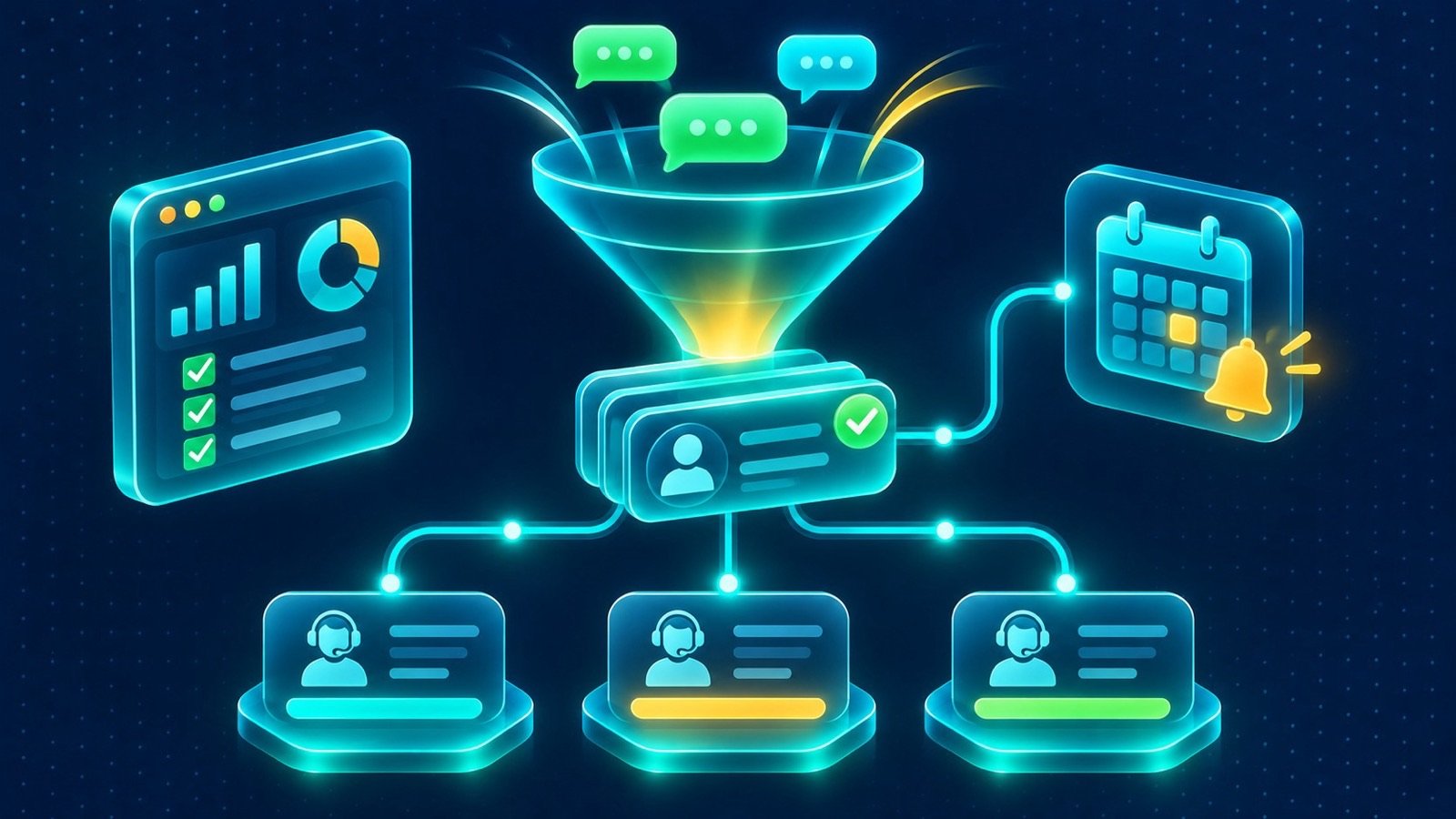
Build WhatsApp lead follow-up automation in Saudi Arabia around five connected steps
- Receive the message. A customer sends an enquiry to the company’s WhatsApp Business number. The WhatsApp Business Platform delivers the relevant message event to the connected integration.
- Identify the customer. The integration checks whether the phone number is already associated with a CRM contact. If a matching record exists, the conversation can be attached to it. Otherwise, the workflow can create a new lead, subject to the business’s data rules.
- Collect the missing information. A configured conversation flow or AI agent asks relevant questions. The answers are saved as structured CRM fields rather than remaining only in the chat.
- Trigger the next action. The CRM assigns an owner, creates a task, updates the opportunity stage or schedules a follow-up according to defined conditions.
- Track the result. Sales staff can see the conversation history, lead status, assigned owner and next action from a shared workspace.
For example, a customer might ask about a maintenance service. The workflow can collect the facility location, type of equipment, service requirement and preferred contact time. It can then route the enquiry to the relevant team instead of leaving the salesperson to discover these details through several disconnected messages.
The integration can also connect to an existing CRM solution or an ERP system when the workflow needs access to operational information. The exact connection depends on the available APIs, permissions and custom development required by those systems.
Lead qualification: ask better questions before assigning the opportunity
Not every incoming message represents a sales-ready opportunity. Some people are comparing options, others need technical information, and some are existing customers requesting support. Qualification helps the business understand the difference before investing significant sales time.
Instead of presenting a long questionnaire, use a short sequence of questions that changes according to the customer’s answers. The information collected should be relevant to the product or service being discussed.
Choose qualification fields that reflect your actual sales process
For a B2B service provider, useful fields might include:
- Company name and business activity.
- Required service or solution.
- Project location, such as Riyadh, Jeddah, Dammam or Khobar.
- Project scope or current operational challenge.
- Expected timeframe or required start date.
- Preferred contact method and suitable time for a discussion.
An e-commerce business would need a different set of fields, potentially including product interest, order reference, delivery question or purchase intent. A property business might ask about property type, preferred area, budget range and whether the customer is buying or renting.
Keep the first interaction focused. If a prospect is asked for too much information before receiving any useful response, the conversation can become frustrating. Collect only what is necessary at each stage and allow a salesperson to handle complex requirements personally.
Automated follow-ups that respect the customer’s stage
A follow-up should be based on the status of the opportunity, not simply on a timer. A person who requested a quotation needs a different message from someone who has not yet explained what they are looking for.
Consider designing separate workflows for these situations:
- New enquiry: Acknowledge the message, collect essential details and explain what happens next.
- Information required: Send a relevant question when a necessary qualification field is missing.
- Assigned to sales: Notify the responsible employee and create a task with the conversation context.
- Quotation requested: Track the quotation status and arrange an appropriate follow-up after it has been shared.
- Decision pending: Send a useful reminder or offer to answer remaining questions, where messaging permissions allow.
- Inactive opportunity: Apply a defined re-engagement process only when the customer’s consent and applicable messaging rules permit it.
Each workflow should include stopping conditions. If the customer replies, opts out, completes a purchase or asks to speak to a person, the automation must respond accordingly. A system that continues sending reminders after the customer has already made a decision can damage the relationship rather than improve it.
Businesses should also define ownership rules. For example, a lead assigned to a salesperson should not be repeatedly reassigned by automated rules while that employee is actively handling the opportunity. Escalation can be configured when a task remains unattended, but the timing and responsible manager should be agreed in advance.
Where AI can improve lead management
AI can make the process more flexible when customers describe their needs in natural language rather than selecting predefined options. An AI agent can interpret an enquiry, identify relevant details, suggest a lead category and prepare a summary for the sales team.
For example, a customer might explain that they need a system for managing multiple branches and ask whether it can connect to an existing accounting platform. An AI agent can identify the likely business requirements, ask which accounting system is currently used and pass the structured information to the appropriate sales team.
For Saudi businesses communicating in Arabic and English, the conversation experience can be configured to support both languages. Arabic Natural Language Processing can help interpret common enquiries, but performance depends on the quality of the knowledge sources, the wording used by customers and the testing performed with real business scenarios. No implementation should assume that every dialect, abbreviation or ambiguous message will be understood correctly.
AI should also operate within defined boundaries. It can collect information, classify enquiries, summarise conversations and recommend next steps. Actions with commercial or operational consequences—such as confirming special pricing, issuing a binding quotation or changing an order—should follow the company’s approval rules.
IntellaQ Flow’s FlowAI agents can work with business documents, draft proposals and support follow-up activities, with a human approving important steps. When connected to CRM workflows, this approach can reduce repetitive preparation while keeping responsibility for significant decisions with the appropriate employee. Explore FlowAI automation services to understand how AI agents can fit into connected business processes.
WhatsApp Business Platform requirements and messaging rules
Businesses planning CRM-connected automation at scale generally need the WhatsApp Business Platform, including Cloud API where appropriate. The standard WhatsApp Business app offers basic features such as greeting messages and quick replies, but it does not provide the same level of programmatic integration and workflow control.
There are several important operational requirements:
- Customer opt-in: Obtain and record the customer’s permission before sending business messages, in line with applicable WhatsApp requirements and local rules.
- Approved templates: Business-initiated messages outside the permitted customer service window generally require an approved message template.
- Customer service window: When a customer messages the business, a 24-hour customer service window applies to standard free-form replies under WhatsApp’s platform rules. Template requirements apply when messaging outside that window.
- Opt-out handling: Provide a way to respect requests to stop receiving messages and ensure the preference is reflected in connected systems.
- Account and API configuration: Set up the relevant business account, phone number, permissions, webhooks and integration credentials.
These requirements should be considered during implementation rather than added after the workflows have been built. Platform rules can change, so the business should check the current WhatsApp documentation before launching or modifying its messaging processes.
CRM reporting: measure the process, not just message volume
Automation is more useful when managers can see whether it is improving the way enquiries are handled. A CRM dashboard should focus on operational and sales outcomes rather than treating the number of automated messages as the main measure of success.
Useful indicators include:
- First-response time: How long it takes for an enquiry to receive an appropriate response.
- Lead assignment time: How quickly a new opportunity reaches the responsible employee.
- Qualification completion: Whether the team collects the information required to assess an opportunity.
- Follow-up completion: Whether assigned tasks are completed within the business’s defined process.
- Conversion by source: Which channels and campaigns generate opportunities that progress through the pipeline.
- Lost-lead reasons: Why prospects decide not to proceed, where the information is available.
These indicators help identify practical improvements. If many enquiries remain unqualified, the initial questions may be unclear. If leads are qualified but do not progress, the issue might be quotation turnaround, pricing, product fit or sales ownership. Reporting should help teams investigate these issues rather than automatically attributing every outcome to the messaging system.
For businesses running paid campaigns, connecting lead sources to CRM records can also help marketing teams understand which campaigns generate meaningful opportunities. This can support better coordination between digital marketing activities and the sales process, while social media management can remain connected to the wider customer communication strategy.
Privacy and customer data in WhatsApp lead follow-up automation in Saudi Arabia
WhatsApp conversations may contain names, phone numbers, company details, project information and other personal data. Connecting these conversations to a CRM creates additional responsibilities around access, storage, retention and processing.
Businesses operating in Saudi Arabia should assess their workflows against the Personal Data Protection Law (PDPL) and its applicable regulations. This includes understanding the purpose for collecting information, providing appropriate notices, managing consent where required, controlling access and defining how long records are retained.
Practical safeguards include role-based permissions, secure API credential management, appropriate encryption, access logs and procedures for handling requests relating to personal data. If an AI service or external integration processes customer information, the business should assess the provider, data flows, contractual arrangements and deployment model before connecting it to production conversations.
Private deployment may be an option for certain AI requirements, but it does not automatically establish legal compliance. The full system architecture and data-handling practices need to be reviewed in the context of the organisation’s actual responsibilities.
How to prepare your business for implementation
A successful project starts with a clear definition of the process. Before development begins, document the following:
- Lead sources: Identify the WhatsApp number, website forms, campaigns and other channels that should create CRM leads.
- Sales stages: Agree on the pipeline stages and define what must happen before a lead moves from one stage to another.
- Qualification rules: Select the questions and required fields for each product, service or customer category.
- Assignment logic: Decide how leads are distributed by service, location, language, team or employee availability.
- Message library: Prepare approved response content, template requirements, escalation messages and opt-out handling.
- Integration scope: Confirm which CRM and ERP records must be accessed or updated, and whether their APIs support the required actions.
- Testing scenarios: Test new leads, duplicate contacts, incomplete information, customer replies, opt-outs, handovers and integration failures.
Start with one clearly defined sales workflow rather than automating every department at once. Run the process with a limited group of employees, review conversation quality and correct assignment or qualification issues before expanding it. This approach gives the business a chance to validate the workflow under real operating conditions.
WhatsApp lead follow-up automation in Saudi Arabia with IntellaQ Flow
Effective lead automation is not simply a chatbot attached to a WhatsApp number. It is a connected workflow that brings customer conversations, CRM records, sales ownership and business information together. The right implementation gives sales teams better context, helps managers monitor the pipeline and creates a more consistent experience for customers.
IntellaQ Flow helps businesses connect AI, CRM and operational systems through solutions designed around their workflows. Whether you need WhatsApp lead capture, qualification, automated task creation or AI-assisted follow-ups, the implementation should reflect your existing sales process and the systems your team already uses.
For a broader overview of the technology and business workflows, read our guide to WhatsApp Business automation in Saudi Arabia. To discuss a lead management workflow for your organisation, contact IntellaQ Flow.
Common questions
What is WhatsApp lead follow-up automation?
It is a connected workflow that captures incoming enquiries, records them in a CRM, assigns ownership, sends permitted follow-up messages and tracks each lead through the sales process.
Can WhatsApp automatically qualify sales leads?
Yes. A configured workflow or AI agent can ask relevant questions, collect information such as service requirements and location, and classify leads using criteria approved by the business. Important decisions can remain subject to staff review.
Do I need the WhatsApp Business Platform to automate lead follow-ups?
For automation at scale and CRM-connected messaging, businesses generally need the WhatsApp Business Platform, such as Cloud API. The standard WhatsApp Business app provides more limited features, including greetings and quick replies.
Can WhatsApp lead automation connect to an existing CRM or ERP?
Yes, subject to the systems' integration capabilities. A custom integration can connect WhatsApp conversations with CRM contacts, sales opportunities and relevant ERP information.
How can businesses manage customer consent and privacy?
Businesses should record how and when customers opt in, respect messaging preferences, restrict access to personal data and define retention procedures. Their implementation should be reviewed against applicable Saudi data protection requirements, including the PDPL.