
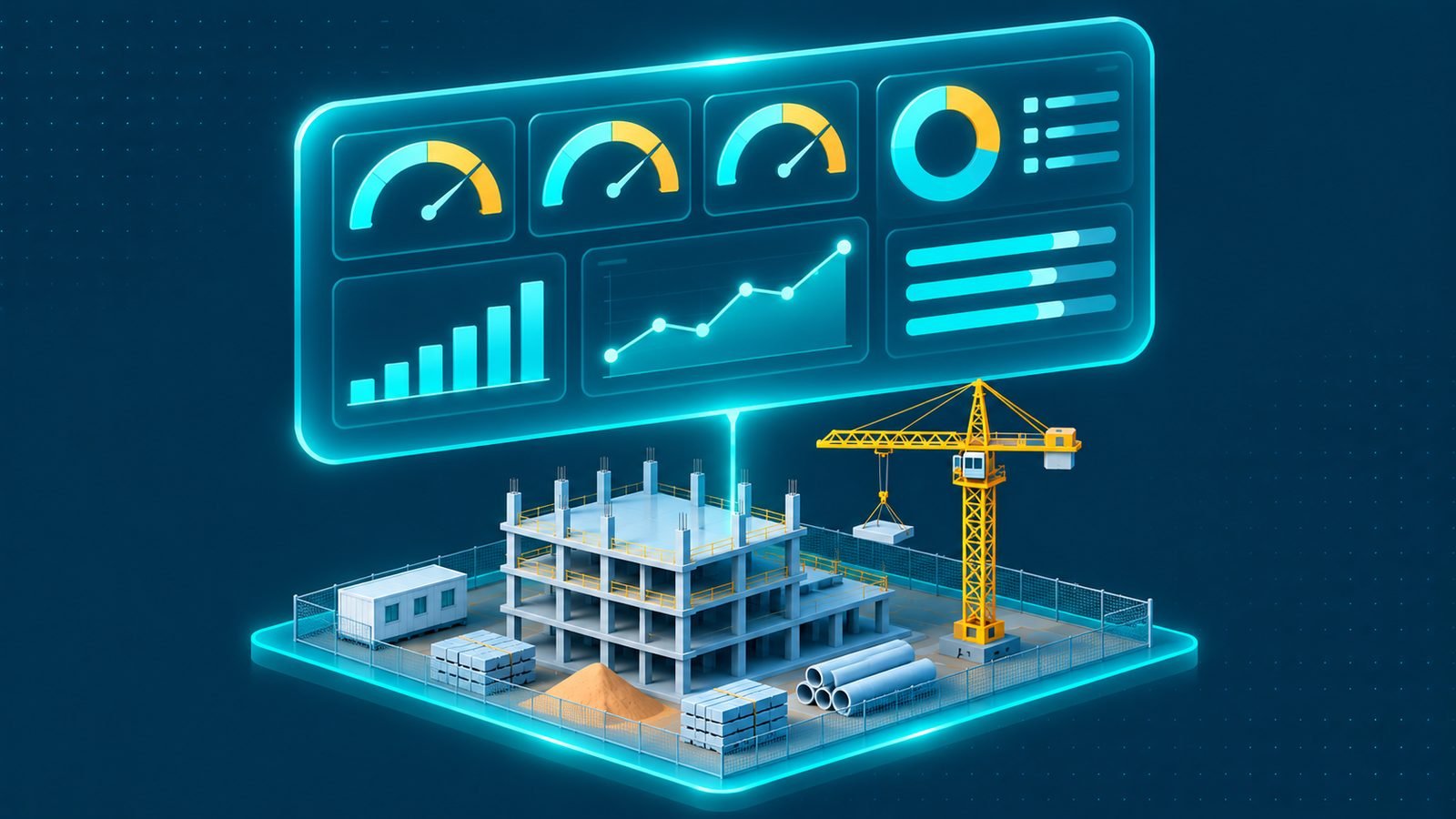
In brief: Learn how to define and review construction project management KPIs for schedule, cost, cash flow, procurement, quality, safety and resources.
Construction project management KPIs help contractors understand whether projects are progressing as planned, using resources effectively and maintaining control over costs and commitments. For companies delivering projects across Riyadh, Jeddah, Dammam, Khobar and other Saudi locations, consistent performance indicators make it easier to identify problems early and coordinate decisions between project teams, procurement and finance. Instead of relying on general progress updates, management can review defined measures supported by reliable project information.
However, collecting large amounts of data does not automatically improve project control. Each indicator needs a clear purpose, an agreed definition, a responsible owner and a dependable data source. The most useful KPI framework focuses on the information that helps managers understand performance and decide what action is needed.
Why construction companies need consistent project KPIs
Construction projects involve several connected activities. Schedule changes can affect labor and equipment requirements. Procurement delays can interrupt planned work. Cost changes can influence financial forecasts, while incomplete billing information can make cash planning more difficult.
Without consistent performance reporting, managers may receive separate updates from site teams, procurement and finance that are difficult to compare. One department may report progress based on completed activities, while another uses financial records or purchasing commitments. Both may be useful, but they need to be interpreted together.
A practical KPI framework helps contractors:
- Understand progress against the approved project schedule.
- Compare actual costs with budgets and identify commitments not yet recorded as actual expenses.
- Monitor billing activity and outstanding financial actions.
- Identify procurement delays and material availability issues.
- Review quality observations and unresolved corrective actions.
- Monitor safety reporting and follow-up activities.
- Understand whether labor and equipment capacity supports planned work.
The objective is to make project performance visible and actionable, not to create reports that employees update without using them.
How to define useful construction project management KPIs
Before selecting indicators, define what management needs to understand. A KPI should answer a specific question about project performance. If an indicator does not support a decision, help identify a problem or clarify an important trend, it may not need to be included in the main management dashboard.
For each KPI, document the following:
- Name and purpose: What the indicator measures and why it matters.
- Definition: The exact meaning of the measure and how it is calculated.
- Data source: The project, financial, procurement or operational records used.
- Reporting frequency: When the information should be updated and reviewed.
- Responsible owner: The person or department accountable for its accuracy.
- Interpretation: What changes or exceptions should prompt further investigation.
- Related action: What management should consider when the indicator highlights a problem.
Construction project management KPIs need clear definitions and data sources
Reliable construction project management KPIs depend on consistent definitions across projects. For example, project progress should be measured using an agreed method rather than allowing each project manager to interpret completion differently.
The data source should also be identified. Schedule indicators may come from approved programme updates, cost measures from project financial records, procurement measures from purchase and delivery records, and quality indicators from inspection and corrective-action registers.
When the same KPI is used across several projects, its definition should remain consistent. This makes consolidated reporting more meaningful and reduces the risk of comparing information that was prepared using different methods.
Schedule and progress KPIs
Schedule indicators help management understand whether project activities are progressing according to the approved programme. They should provide more information than a general statement that a project is on track or delayed.
Useful schedule measures include:
- Planned versus actual progress: Compares the progress expected by the reporting date with the progress recorded by the project team.
- Milestone status: Shows whether important project milestones are completed, approaching or delayed.
- Activity slippage: Identifies activities that have moved beyond their planned dates.
- Critical activity status: Highlights activities whose delays may affect important project completion dates.
- Look-ahead readiness: Shows whether upcoming activities have the required approvals, labor, equipment and materials.
The primary data sources are the approved project schedule, progress updates, site reports and activity records. Project managers should investigate significant differences between planned and actual progress, identify the causes and record corrective actions.
Cost KPIs: budget, actual and committed costs
Cost reporting should help management understand how project spending compares with the approved financial plan. Looking only at actual expenses can provide an incomplete picture because the company may already have purchase orders, subcontractor commitments or other obligations that have not yet appeared as recorded costs.
Important cost indicators include:
- Budget versus actual cost: Compares the approved project budget with costs recorded to date.
- Committed cost: Tracks financial commitments such as approved purchase orders and relevant subcontractor commitments.
- Cost variance: Identifies differences between the planned financial position and actual or forecast costs.
- Cost by category: Shows how spending is distributed across labor, materials, equipment, subcontractors and other project activities.
- Forecast cost position: Provides an updated view of expected project costs based on available information.
Data should come from approved budgets, accounting records, purchase orders, expense transactions and project cost allocations. Project managers and finance should agree on how commitments and actual costs are classified to avoid double counting or incomplete reporting.
For a deeper explanation of project cost control, see job costing for Saudi contractors. Contractors can also explore construction job costing capabilities for more focused project cost visibility.
Cash flow and billing KPIs
Project profitability and cash movement are related but different management concerns. A project may show progress and recorded revenue while billing documentation or payment collection remains outstanding. Contractors therefore need indicators that connect completed work, billing activity and cash position.
Useful measures include:
- Work completed but not yet billed: Identifies recorded progress that has not moved into the relevant billing process.
- Billing submitted: Tracks the value and status of invoices or payment applications submitted for review.
- Outstanding receivables: Shows amounts that remain unpaid and require follow-up.
- Billing versus progress: Compares billing activity with recorded project progress to identify differences that need investigation.
- Cash flow forecast: Provides a view of expected receipts and project-related payments based on available records.
Sources may include progress records, approved billing documents, invoices, receivables and finance forecasts. These indicators should be reviewed with project and finance teams because billing status and payment timing can be affected by documentation, review and other project-specific circumstances.
For additional guidance on work-in-progress reporting, read WIP reporting for construction companies in Saudi Arabia.
Procurement and material availability KPIs
Procurement performance affects whether planned construction activities can proceed. Project teams need visibility of material requests, purchasing progress and deliveries, particularly when an item is required for an upcoming activity.
Useful procurement indicators include:
- Material request status: Shows requests that are pending, approved, ordered or fulfilled.
- Purchase order status: Tracks orders that are open, partially received or completed.
- Delivery performance: Compares expected delivery dates with recorded receipt information.
- Outstanding material requirements: Identifies items needed for upcoming activities that have not yet been fulfilled.
- Receiving discrepancies: Tracks differences between ordered and received quantities or specifications.
Data should come from material requisitions, purchase orders, supplier delivery records, warehouse receipts and project schedules. Procurement indicators become more useful when they are linked to the activities that depend on the materials.
Quality and safety performance indicators
Quality and safety information should be included in project reviews because they affect work execution, corrective actions and overall project control. Indicators should help teams understand the status of inspections, reported issues and follow-up responsibilities.
Quality measures may include:
- Inspection activities completed and awaiting review.
- Open non-conformance or quality observations.
- Corrective actions awaiting completion or verification.
- Repeated issues affecting the same work area or activity.
- Outstanding material or workmanship inspections.
Safety measures may include recorded observations, reported incidents, open corrective actions, completed inspections and follow-up status. The contractor should define these indicators according to its internal safety processes and the information it needs to review.
Relevant data sources include inspection records, quality registers, safety reports and corrective-action logs. Management should focus on understanding patterns, addressing unresolved issues and confirming that assigned actions are followed through. Indicators should support improvement rather than encourage incomplete or misleading reporting.
Resource KPIs for labor and equipment
Resource indicators help project managers understand whether available capacity supports planned activities. They should connect workforce and equipment information with the project schedule rather than measure utilization without considering operational requirements.
Useful measures include:
- Labor availability: Shows whether the required employees and skills are available for upcoming work.
- Workforce assignment: Tracks employee deployment across activities and project locations.
- Equipment utilization: Provides visibility into equipment assignments and periods of use or availability.
- Equipment readiness: Highlights maintenance, availability or deployment issues that could affect planned activities.
- Resource conflicts: Identifies overlapping requirements for shared employees, equipment or specialist teams.
Sources include workforce assignments, attendance and timesheet records where used, equipment registers, maintenance records and project schedules. Resource measures should be interpreted alongside progress and upcoming demand. High utilization does not automatically mean resources are being used effectively if critical activities remain delayed.
How to review KPIs and turn reports into decisions
Collecting indicators is only useful when project teams review them and agree on actions. Establish a reporting routine that gives each responsible person enough time to verify information before management reviews the results.
A practical review process should include:
- Validate the information: Confirm that the underlying records are current and complete.
- Compare performance: Review actual information against approved plans, budgets and relevant project expectations.
- Identify exceptions: Focus on significant changes, unresolved issues and indicators that need investigation.
- Understand the cause: Ask the responsible department or project team to explain the underlying issue.
- Agree on actions: Assign a responsible person and record the required follow-up.
- Review progress: Check whether previous actions were completed and whether the project position has changed.
Not every indicator needs to be discussed in every meeting. Site teams may need frequent operational reviews, while senior management may focus on consolidated project performance and major exceptions. The reporting structure should match the decisions each group is responsible for making.
Use ERP dashboards to improve project visibility
When project information is stored in separate spreadsheets and departmental applications, preparing a consolidated KPI report can require repeated data collection and reconciliation. An ERP system can connect project, procurement, cost and finance records to support more consistent reporting.
Useful capabilities include:
- Project dashboards with clearly defined indicators.
- Links between budgets, actual costs and commitments.
- Procurement and material status reporting.
- Billing and receivables visibility.
- Quality and safety action tracking.
- Labor and equipment assignment information.
- Role-based access to relevant project reports.
IntellaQ Flow develops custom ERP systems for Saudi contractors, connecting project, procurement, cost and finance workflows according to business requirements. For more information about using connected reports to support management decisions, see how ERP systems improve decision-making through real-time reports and dashboards.
Contractors can also explore the broader guide to ERP for construction companies in Saudi Arabia.
Build a KPI framework that supports better project control
Effective construction project management KPIs give contractors a consistent way to monitor schedule, cost, cash and billing, procurement, quality, safety and resources. Their value depends on clear definitions, reliable data sources, responsible owners and regular reviews that lead to practical decisions.
Start with the indicators that address your company’s most important management questions. Make sure every measure has an agreed definition and can be traced to reliable project records. Review exceptions with the relevant teams, assign actions and refine the reporting framework as business requirements change.
To discuss an ERP system that connects project information and supports meaningful performance reporting across your contracting operations, request a demo from IntellaQ Flow.
Common questions
What are construction project management KPIs?
They are measurable indicators used to understand project performance across areas such as schedule, cost, cash flow, procurement, quality, safety and resources. They help project managers identify issues, monitor progress and make informed decisions.
Which KPIs should a construction company monitor?
The most useful indicators depend on the company's projects and management priorities. Common categories include schedule progress, budget versus actual cost, committed cost, billing status, procurement progress, quality observations, safety reporting and resource utilization.
How should contractors define project KPIs?
Each KPI should have a clear purpose, calculation method, reporting frequency, responsible owner and reliable data source. Definitions should be consistent across projects so management can interpret reports accurately.
How can ERP software improve construction KPI reporting?
An ERP system can connect project, procurement, cost and financial records to provide more consistent reporting. It can also help authorized managers review performance information without repeatedly collecting data from separate spreadsheets.
More on construction project management KPIs
- ERP for Construction Companies in Saudi Arabia: A Practical Guide
- Construction Job Costing Software for Saudi Arabia budget vs committed vs actual, live
- Contracting
- Construction ERP Data Migration: A Practical Guide for Saudi Contractors
- ERP for Small Construction Companies: A Practical Guide for Saudi Contractors