In brief: Learn how managing multiple construction projects improves portfolio visibility, resource sharing, reporting and approvals for Saudi contractors.
Managing multiple construction projects requires more than keeping individual project schedules up to date. Contractors operating across Riyadh, Jeddah, Dammam, Khobar and other Saudi cities need a reliable way to understand their entire project portfolio, coordinate shared resources, monitor performance and make decisions without waiting for disconnected reports from different teams. As the number of active contracts grows, the challenge shifts from managing individual sites to managing the relationships between projects.
A company may have several projects progressing at the same time, each with its own client requirements, deadlines, subcontractors, procurement needs and financial commitments. A decision that benefits one project can create a shortage or delay elsewhere. Effective portfolio management helps management see these connections, understand priorities and direct the company’s resources toward its overall objectives.
Why managing multiple construction projects becomes challenging
Each construction project has its own operational structure. Site teams manage daily activities, project managers coordinate schedules, procurement teams source materials, finance monitors commitments and senior management oversees the wider business. When these activities operate independently, information becomes fragmented.
Common challenges include:
- Limited portfolio visibility: Management cannot easily compare the status of all active projects using consistent information.
- Competing resource requirements: Projects may need the same equipment, specialist employees, supervisors or subcontractors at the same time.
- Disconnected reporting: Departments prepare reports using different formats, reporting periods and definitions.
- Slow approvals: Purchase requests, variations and other decisions may wait because responsibilities or approval routes are unclear.
- Late identification of risks: Delays, cost pressures and resource shortages may become visible only after they affect project delivery.
These challenges become more significant when a contractor works across different locations or manages projects with different scopes. A company operating in Riyadh and the Eastern Province, for example, needs to coordinate resources and management decisions without losing sight of each project’s local requirements.
Build a clear portfolio view across all active projects
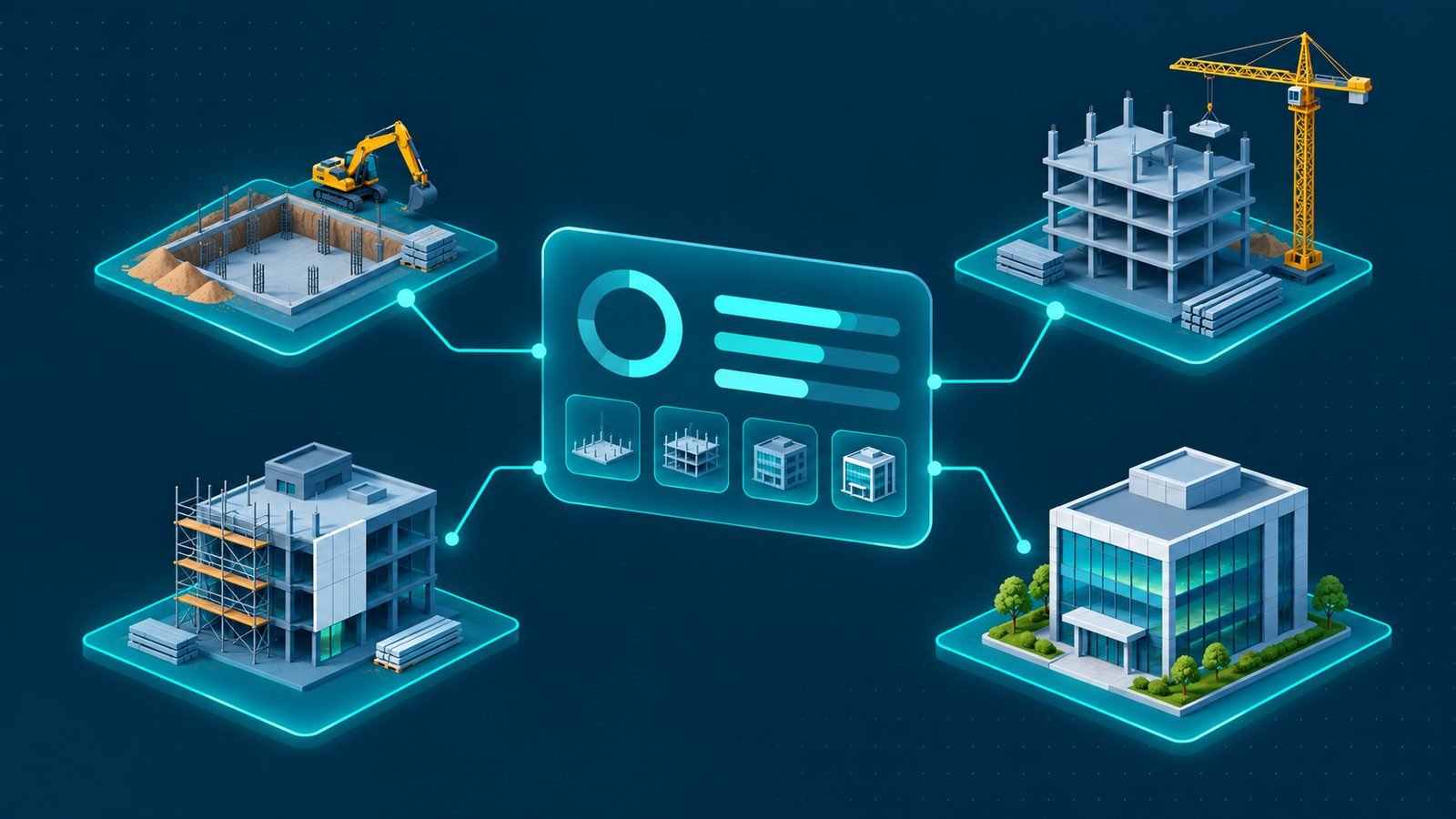
A portfolio view gives senior management a consolidated picture of the company’s active work. Instead of reviewing each project separately and trying to combine the information manually, management can use common indicators to understand the overall position.
A useful portfolio overview should include:
- Project name, client, location and responsible project manager.
- Contract value, approved budget and current financial position.
- Planned start date, target completion date and major milestones.
- Current progress and important upcoming activities.
- Major procurement requirements and outstanding purchase requests.
- Key risks, unresolved issues and decisions requiring management attention.
- Project status, including items that need intervention or escalation.
The objective is not to replace detailed project reporting. Site managers still need operational detail, and project managers still need their own schedules and cost information. The portfolio view provides a common management layer that makes it easier to identify which projects need attention and where decisions may affect other work.
Managing multiple construction projects through consistent status reporting
Consistent reporting is essential when managing multiple construction projects because management needs to compare information from different teams without repeatedly interpreting different formats. Establish standard definitions for project progress, schedule status, budget position, procurement delays and outstanding approvals.
For example, every project should report its progress against an agreed baseline and identify the reasons for significant deviations. A project marked as delayed should include the cause, expected impact, responsible person and proposed corrective action. This turns a status update into information that management can act on.
Reporting frequency can differ according to project needs, but the format and definitions should remain consistent. A shared reporting structure makes portfolio reviews more useful and reduces the time spent reconciling departmental spreadsheets.
Coordinate resources across projects instead of managing them in isolation
Resource sharing is one of the most important responsibilities for contractors with several active projects. Equipment, specialist employees, supervisors, vehicles and subcontractors may serve more than one site. If each project plans its requirements independently, the company can face double bookings, idle resources or unexpected rental costs.
A central resource planning process starts by identifying what the company owns, what it has available and where each resource is currently assigned. Project teams should communicate their upcoming requirements early enough for management to identify conflicts and agree on priorities.
Managing multiple construction projects with shared equipment and teams
Managing multiple construction projects becomes more predictable when resource assignments are visible across the organization. A central view can show where equipment is deployed, when it is expected to become available and whether another project has a confirmed requirement for it.
The same principle applies to employees and specialist teams. Management should be able to understand which projects require particular skills, whether employees are already assigned elsewhere and when their current commitments are expected to finish.
Before transferring a resource, consider:
- The urgency and contractual priority of each project’s requirement.
- The expected duration of the assignment and transportation needs.
- Whether the resource is suitable for the receiving project’s scope.
- The effect of the transfer on the project losing the resource.
- Any additional costs, approvals or operational arrangements required.
Resource sharing should not be treated as an informal agreement between site teams. Assignments and transfers need clear ownership and documentation so that project managers understand what has changed and why.
Use consolidated reporting to understand business performance
Project-level reports explain what is happening at individual sites. Consolidated reporting explains how the entire contracting business is performing. Both are necessary, but they serve different management purposes.
A consolidated report should bring together information from projects using consistent reporting periods and definitions. It should help management answer questions such as:
- Which projects are progressing according to their approved plans?
- Which projects have significant schedule or financial deviations?
- Where are procurement requests or approvals creating bottlenecks?
- Are shared resources being used according to company priorities?
- Which projects require additional management attention?
- What upcoming commitments could affect the company’s capacity?
Financial reporting should also connect project information with the wider company view. Management needs to understand contract values, approved budgets, commitments, costs and relevant financial updates without treating every project as an isolated business.
Detailed job costing remains important for understanding project-level costs and financial performance. Contractors that need more focused tools for this area can explore construction job costing capabilities. In portfolio reporting, the priority is to bring the relevant project information together and make it useful for management decisions.
Establish clear approval workflows across the organization
As a contracting business grows, decisions increasingly involve more than one department. A purchase request may require review by a project manager, procurement, finance and an authorized manager. A variation or additional resource request may require a different approval route.
Without defined workflows, employees may not know who should approve a request, which information must be attached or how to follow its status. Requests can remain in email conversations or messaging groups, making it difficult to establish whether a decision is pending, approved or rejected.
Contractors should define approval workflows according to the type of transaction, organizational responsibility and delegated authority. The process should clarify:
- Who can submit each type of request.
- Which documents and supporting information are required.
- Who reviews the request at each stage.
- Who has final approval authority.
- How rejections, amendments and resubmissions are handled.
- How the final decision is recorded and communicated.
Approval visibility is particularly valuable for companies operating several projects. Management can identify requests waiting for action, understand which department is responsible and see whether a pending decision could affect a project milestone or procurement commitment.
Standardize project governance without ignoring site differences
A contractor needs common management standards, but every project will not follow exactly the same operational pattern. A factory construction project in Jubail may have different procurement requirements and technical coordination needs from an infrastructure project in Jeddah or a warehouse project in Riyadh.
The right approach is to standardize the management framework while allowing project-specific details. Common standards should cover reporting, approvals, document control, responsibilities, financial monitoring and escalation. Individual projects can then maintain their own schedules, technical requirements, contractual obligations and site procedures.
This balance helps the company maintain control without forcing every project into an identical operating plan. It also makes it easier to onboard new projects because teams already understand the core processes and reporting expectations.
Make portfolio reviews a regular management practice
Consolidated information becomes valuable when management uses it consistently. A regular portfolio review gives project managers and department heads an opportunity to discuss progress, identify shared constraints and agree on actions.
A practical review agenda can include:
- Project status: Review milestones, progress and significant changes since the previous meeting.
- Resource conflicts: Identify equipment, employee or subcontractor requirements that overlap between projects.
- Procurement: Review critical materials, delayed orders and requests requiring decisions.
- Financial position: Discuss budget concerns, commitments and relevant cost developments.
- Approvals and decisions: Review pending requests and assign responsibility for outstanding actions.
- Risks and corrective actions: Confirm the owner and expected completion date for each agreed action.
Every review should produce documented decisions and assigned follow-up actions. Otherwise, the same issues may appear in successive meetings without a clear resolution. A consistent review process also helps senior management distinguish between routine site matters and issues that require intervention at company level.
How an ERP system supports construction portfolio management
When project information is distributed across spreadsheets, email, accounting tools and separate departmental systems, consolidating it can require significant manual effort. An ERP environment can connect important business processes and provide authorized users with a more coordinated source of operational and financial information.
For contractors, the system should support the relationship between projects, procurement, costs, finance, employees and approvals. This does not mean every employee needs access to every business record. Role-based permissions should ensure that teams see the information relevant to their responsibilities.
Useful capabilities include:
- Centralized project and contract records.
- Consistent project status and management reporting.
- Visibility of shared resources and assignments.
- Connected procurement and project requirements.
- Documented approval workflows and decision histories.
- Financial information linked to the relevant projects.
- Arabic-first interfaces and workflows suited to Saudi business operations.
IntellaQ Flow develops custom ERP systems for Saudi contractors. Its work includes a custom construction ERP for DTC, a contracting company in Khobar, covering projects, costs, procurement and finance in one system. You can learn more about the implementation in the DTC construction ERP case study.
Contractors evaluating their broader technology requirements can also explore ERP solutions for contracting companies and the informational guide to ERP for construction companies in Saudi Arabia.
Build a more coordinated approach to managing multiple construction projects
Successful portfolio management depends on visibility, coordination and timely decisions. Contractors need to understand the status of every project, allocate shared resources according to business priorities, consolidate reporting and establish approval workflows that keep work moving.
These practices are relevant whether a company manages several projects in one city or operates across Riyadh, Jeddah, Dammam, Khobar and Jubail. The details of each contract may differ, but the need for reliable information and clear accountability remains the same.
The first step is to review how project information currently moves between site teams, departments and senior management. Identify where reports are inconsistent, where resource conflicts occur and where approvals become difficult to track. From there, define the processes and system capabilities needed to support the company’s portfolio.
If your business is looking to improve visibility and coordination across its construction projects, request a demo from IntellaQ Flow to discuss an ERP approach aligned with your contracting operations.
Common questions
What is the biggest challenge in managing multiple construction projects?
The main challenge is maintaining a reliable view of progress, costs, resources and decisions across all active projects. Without consistent reporting and clear responsibilities, management may discover conflicts or delays too late.
How can contractors improve the way they run several projects at once?
Contractors can establish common reporting standards, centralize project information and define approval responsibilities. Regular portfolio reviews also help management identify resource conflicts and prioritize decisions.
How should resources be shared between construction projects?
Resource sharing should be based on project priorities, required skills, equipment availability and approved schedules. A central allocation process helps prevent double booking and makes competing requirements visible.
Can ERP software support construction portfolio management?
Yes. An ERP system can bring project, procurement, finance and operational information into a coordinated environment. This gives authorized teams a more consistent basis for reporting, approvals and management decisions.
More on managing multiple construction projects
- ERP for Construction Companies in Saudi Arabia: A Practical Guide
- Construction Job Costing Software for Saudi Arabia budget vs committed vs actual, live
- Contracting
- Construction Material Requisition Process: A Practical Guide for Saudi Contractors
- Construction Workforce Management: A Practical Guide for Saudi Contractors